Wine Tours in Tuscany - About Angie - +39 3333185705 - angie.chianti@gmail.com

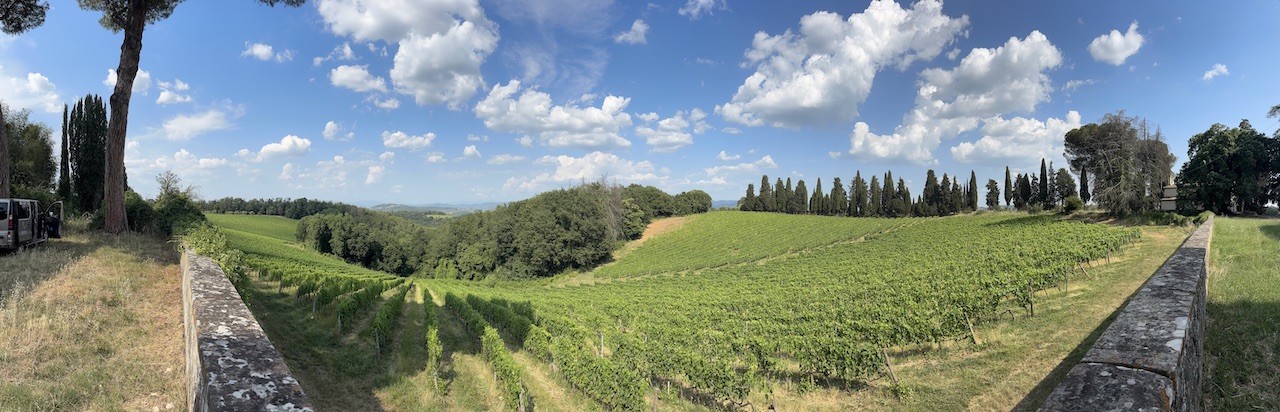
Super Tuscan wines were born from a quiet revolution. Free from traditional rules, they reshaped modern Italian winemaking and produced some of the most celebrated bottles in the world. Here is everything you need to know about them.
A Break from Tradition
Until the late twentieth century, Tuscan wines were defined by strict appellation laws. Chianti, the region’s most famous wine, had clear requirements regarding grape varieties and production methods. While these rules preserved regional identity, they also limited experimentation.
In the 1970s, the situation became particularly difficult. Cheap Chianti was being mass produced and shipped worldwide, often boosted with the addition of white grapes such as Trebbiano a practice that was legal at the time and widely used. The wine’s reputation was suffering.
A small number of Tuscan producers decided to respond. They started experimenting with international grape varieties such as Cabernet Sauvignon and Merlot, often blending them with Sangiovese or vinifying them alone. They aged wines in small French oak barrels, focused on vineyard selection, and aimed for quality above all else.
Because these wines did not fit existing regulations, they were classified as simple table wines the lowest official designation in Italian wine law despite their extraordinary quality. That contradiction is where the Super Tuscan story begins.
Why They Are Called “Super Tuscan”
The term Super Tuscan was not created by producers, nor does it appear in official wine laws. It emerged organically among critics and journalists particularly in the English speaking wine press to describe wines that were unmistakably Tuscan in character, yet superior in ambition and execution.
Super does not mean bigger or more powerful. It refers to a step beyond traditional boundaries. Today these wines are officially classified as IGT (Indicazione Geografica Tipica), a category created specifically to accommodate them while preserving geographic identity.
Bolgheri: Where It All Began
If there is one place that defines the Super Tuscan story, it is Bolgheri.
Bolgheri is a small coastal zone in the Maremma, the wild southwestern stretch of Tuscany facing the Tyrrhenian Sea. I love going there. The countryside is unlike anywhere else in Tuscany, flatter, wilder, with a light and an atmosphere shaped by the proximity of the sea. From the vineyards of some estates, and from the terraces of others, you can see the Mediterranean. That maritime influence the sea breezes, the warm dry summers, the gravelly soils, creates conditions that are ideal for Cabernet Sauvignon and Merlot, the great Bordeaux varieties that elsewhere in Tuscany can struggle to ripen fully.
In 1968, a producer called Tenuta San Guido made the first vintage of Sassicaia, a blend of 85% Cabernet Sauvignon and 15% Cabernet Franc, aged in small French oak barrels. It was classified as a simple table wine. In 1974, a 1968 Sassicaia entered a tasting organised by Decanter magazine and beat an assortment of Bordeaux wines that were the traditional winners of such events. The wine world took notice.
Sassicaia is now considered the defining Super Tuscan. Production is limited to around 180,000 bottles annually, and in a good year a bottle can cost €300 to €400 in a restaurant. It has its own DOC Bolgheri Sassicaia DOC, the only single estate DOC in Italy.
To be classified as Bolgheri DOC (the broader appellation established in 1994), a red wine must contain between 10 and 80% Cabernet Sauvignon, up to 80% Merlot, and up to 30% other local red varieties, with a minimum aging of 24 months. Other famous estates in Bolgheri include Ornellaia and Masseto wines that regularly appear among the most collected and expensive in the world.
Super Tuscans Beyond Bolgheri
Bolgheri is the most famous Super Tuscan zone, but it is not the only one. Super Tuscan wines are produced across Tuscany, wherever producers have chosen quality and freedom over classification.
One of the most important is Tignanello, produced by Antinori in the Chianti Classico hills. Tignanello broke the rules in a different way: it blended Sangiovese with Cabernet Sauvignon and Cabernet Franc, aged the wine in French barriques, and eliminated the white grapes that were then required in Chianti. It became a model for what Sangiovese could do when treated with the same care as the greatest wines of Bordeaux.
Other celebrated Super Tuscans include Solaia (Antinori), Luce (Frescobaldi), Ornellaia, and Masseto the last of which, a pure Merlot from Bolgheri, is among the most expensive wines produced in Italy.
What these wines share is not a grape variety or a production method, but an intention: to make the best possible wine from a specific piece of Tuscan land, regardless of what the rules say.
Super Tuscan and Sangiovese
Although international grapes often take centre stage in discussions about Super Tuscan wines, Sangiovese remains a crucial part of the story.
Some of the most compelling Super Tuscans are those that reinterpret Sangiovese outside traditional Chianti regulations. Free from constraints on blending or aging, producers revealed new dimensions of Tuscany’s most important grape wines of greater concentration, complexity and longevity than traditional Chianti ever allowed.
Rather than replacing tradition, Super Tuscans expanded it.
How to Recognise a Super Tuscan
Super Tuscan wine labels work differently from most Italian wines. Where a traditional Italian wine label shows the region or the grape variety Chianti Classico, Brunello di Montalcino a Super Tuscan typically shows only the name of the wine itself: Sassicaia, Tignanello, Ornellaia, Masseto.
This was partly intentional. Producers wanted to distance themselves from the classifications that had limited them, and create wines known by name rather than by category.
On the label you will usually find: the name of the wine, the producer, the vintage, and the designation IGT Toscana or IGT Bolgheri. That IGT which officially means a simpler category than DOC or DOCG is, paradoxically, a sign of prestige for these wines.
What Do Super Tuscans Taste Like?
The flavour profile of Super Tuscan wines varies enormously because of the large geographical area and the diversity of grape varieties involved.
Bolgheri style wines (Cabernet Sauvignon and Merlot dominant) tend to be full bodied, structured and elegant, with dark fruit, cedar, tobacco and graphite notes. They age exceptionally well.
Sangiovese based Super Tuscans (like Tignanello) have more of the classic Tuscan character earthiness, dried cherry, leather with additional structure and complexity from the international varieties and French oak.
All Super Tuscans share a commitment to balance and precision. They are not necessarily bigger or more powerful than traditional Tuscan wines. They are simply more carefully made, with longer aging potential and a more international style of elegance.
Food Pairing
Super Tuscans pair beautifully with rich, structured food. The firm tannins and good acidity make them natural companions for aged cheeses, grilled vegetables, mushroom dishes, and hearty pasta.
The Bolgheri style wines, with their Bordeaux character, work particularly well with dishes that have depth a perfect counterpoint to the wine’s structure.
For a truly Tuscan experience: bruschetta with local olive oil, aged Pecorino, and a glass of Sassicaia or Tignanello on a warm evening.
Super Tuscan Today
Super Tuscan wines no longer represent rebellion. They represent confidence. They show what happens when tradition and innovation are allowed to coexist without fear.
They also represent, for many visitors to Tuscany, the discovery that Italy produces wines that can stand alongside the greatest bottles in the world not by imitating Bordeaux, but by bringing Tuscan soil, climate and sensibility to varieties that thrive here in a completely different way.
The revolution these wines started in the 1970s ultimately improved Italian wine law, reshaped global perceptions of Italian wine, and in the case of Bolgheri created one of the most exciting wine landscapes in the world: a coastal Tuscany where you can stand in a vineyard and see the sea, and drink a wine made from grapes that have found, in this unlikely corner of Italy, something close to a perfect home.
Explore our Chianti and Super Tuscan wine tour from Florence Or our private wine tours.