Wine Tours in Tuscany - About Angie - +39 3333185705 - angie.chianti@gmail.com


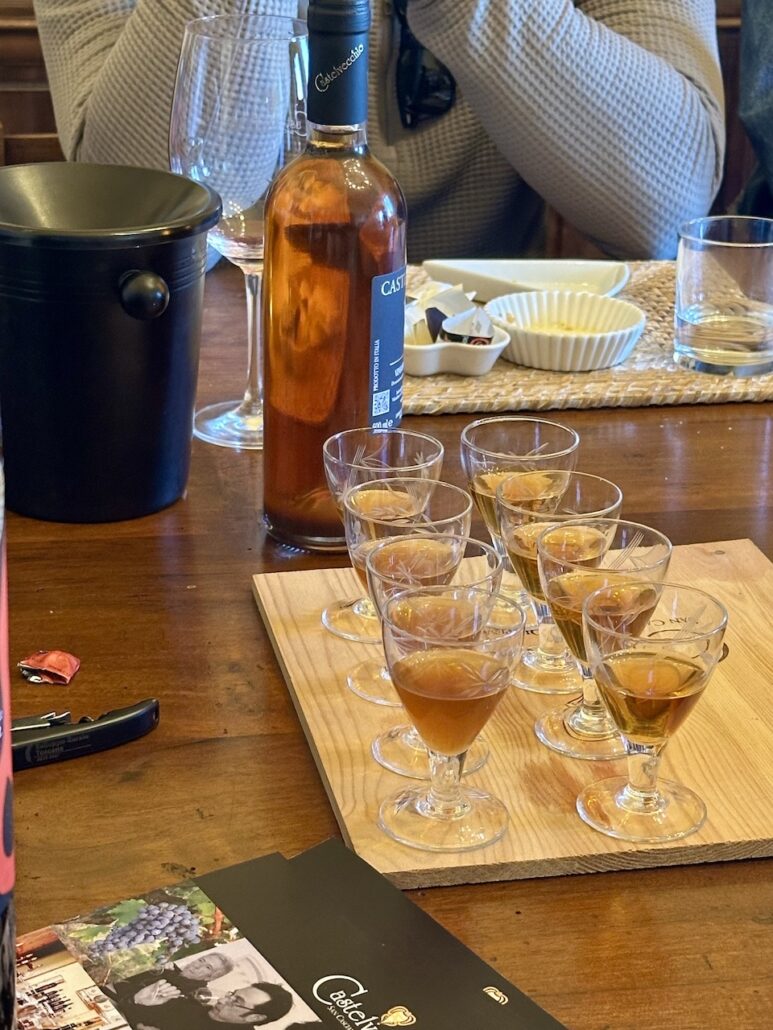
If you visit a Tuscan family in the countryside, the first thing they offer you is Vin Santo. Not coffee, not water, Vin Santo. At any hour of the day, regardless of the occasion. It is the Tuscan gesture of welcome, offered to guests the way other cultures might offer tea. I grew up with this. My grandfather made it at home, as did almost every family in the countryside in Tuscany. Everyone had a small barrel somewhere ,in the cellar, under the stairs, in a cool corner of the house. Vin Santo was not a special occasion wine. It was simply what you offered when someone came through the door.
That tradition has become rarer in recent years, but it hasn’t disappeared. On some of our wine tours, we still visit small family producers who open a bottle of their own Vin Santo at the end of the tasting poured into small glasses alongside cantucci, the dry almond biscuits you dip into the wine. It is one of those moments that stays with people long after the tour is over.
What Is Vin Santo?
Vin Santo, which means “holy wine” in Italian, is a traditional Tuscan dessert wine made from dried grapes. It is amber in colour, sweet and complex, with aromas of caramel, honey, dried figs, almonds and vanilla. Nothing else quite tastes like it.
It belongs to the family of wines known as passiti, wines made from grapes that have been left to dry after harvest, concentrating their sugars before fermentation. But Vin Santo has its own particular character, shaped by the specific way it is made and the long years it spends aging in small barrels.
Why is it called holy wine? Nobody agrees entirely. Some say it is because it was traditionally used in religious ceremonies. Others say the pressing takes place around Christmas time, giving it a sacred connection to the season. And others, perhaps the most convincing, say that the name refers simply to the extraordinary patience required to make it. Three years minimum in the barrel, sometimes much longer. In Tuscany, patience has always been a kind of holiness.
How Vin Santo Is Made
The production of Vin Santo begins at harvest in September and October, when the best bunches of grapes are selected by hand. These grapes are then left to dry for approximately four months, hung from the ceiling on strings, or laid on straw mats in well ventilated rooms called vinsantaie, at temperatures between 10 and 15 degrees Celsius. The drying concentrates the sugars and transforms the character of the fruit entirely.
In the Chianti zone, two main types of Vin Santo are produced. Vin Santo del Chianti is made from white grapes, usually Trebbiano and Malvasia and produces the classic sweet golden wine most people associate with the name. Vin Santo del Chianti Occhio di Pernice (which means “eye of the partridge”) is made from Sangiovese and produces a darker, richer, more complex wine with a distinctive amber-rose colour.
Once the grapes are sufficiently dried, they are pressed and the must is transferred into small chestnut or oak barrels of about 50 litres the caratelli. Inside each barrel is a small quantity of madre, meaning “mother” a dark, dense sediment left from the previous year’s production, rich in yeasts that will slowly begin the fermentation. The barrels are then sealed and left undisturbed for a minimum of three years.
The result is a wine of extraordinary depth sweet but rarely cloying, with an oxidative complexity that develops over years and sometimes decades.
How to Drink Vin Santo
The most traditional pairing is with cantucci toscani hard, dry almond biscuits made for dipping. You take a biscuit, you dip it into the wine, you wait a moment for it to soften slightly, and then you eat it. It sounds simple. It is one of the great pleasures of Tuscan life.
Vin Santo also pairs beautifully with aged cheeses Pecorino Toscano stagionato, blue cheese, strong gorgonzola. And with certain desserts: dark chocolate, almond cake, fruit tarts.
Serve it slightly chilled, in small glasses. You don’t drink much of it, you savour it slowly, at the end of a meal, in good company. Which is, come to think of it, exactly how my grandfather always served it.
Taste It for Yourself
Vin Santo is one of those wines that is difficult to fully understand without tasting it at source , in the place where it was made, poured by the person who made it, alongside the cantucci that have been made in the same way for generations.
On several of our wine tours from Florence, we visit small family wineries in the Chianti countryside that still produce Vin Santo in the traditional way. It is not something you will find in every winery, fewer and fewer producers have the patience for those three years in the barrel. But when you find it, it is worth every minute of the wait.
Explore our small groups Chianti wine tours from Florence Or our private wine tours